
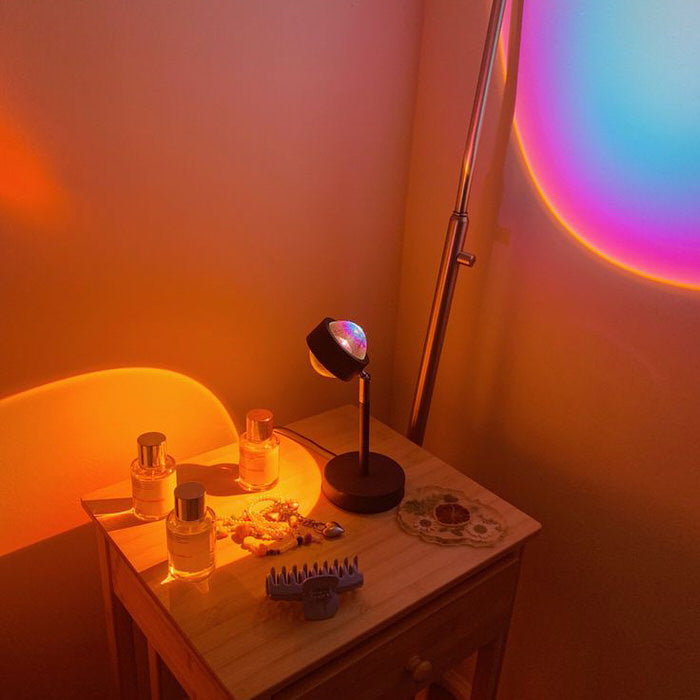
A scene is a part of an interior space whose purpose is to evoke some emotional state.
A system is a part of a space whose purpose is to serve a particular function or solve a utilitarian need.
Areas that contain neither a scene nor a system tend to become cluttered or barren, as their purpose is not defined.
You can combine scene with system to make scenic systems (areas that are predominantly useful with emotionally charged elements, such as a work bench area with a framed photo of Dad), or systemic scenes (areas that are predominantly intended to evoke emotion but that also serve a utilitarian purpose or solve a problem, such as adding an armoire to the front door room if it lacks a closet).
Systems often are not super-aesthetic (the term is eyesores). Think plastic storage bins, TV dinner tables, cellphone holders, extension cords, stand-up desks, media centers, media collections, worn-out but still functional furniture, or possessions stored in cardboard boxes.
By contrast, scenes are generally comprised of items that are, by definition, not useful (just plain stuff; nice stuff, but stuff all the same). Examples include photographs, knickknacks or any sentimentally important items, any purely decorative item, works of art, or the surfaces needed to store these items.
A more minimalist approach to interiors focuses on reducing the number or complexity of scenes. The idea is not to evoke emotions, but to focus on evoking calm through simplicity, the emotional freedom of a “blank slate,” or the serenity of the undefined.
However, some people find such minimalist aims overly sterile, emotionally distancing, dull, or overwhelming. That “undefined,” “open” quality can trigger uncomfortable feelings that have now been given too much space to come to the forefront. And so what one person might find calming and opening feels agitating and closing to someone else. There is this risk associated with it.
That said, an overabundance of scenes (maximalism) can come at the expense of systems. Certain practical needs are not met, leading either to inurement of the space’s shortcomings or “improvised” solutions and inefficient use of space. This inefficiency can then create clutter/disorder or dust magnetism, and disrupt both the sense of cohesion of the space and the emotional intention of the scene(s) in question.
This is what I call a “negative scene,” which occurs when the emotional impact of the space is stress. It is, of course, not an *intended* effect, but it is the *result* of the overworked or, indeed, neglected use of scenes over systems.
When we allow this negative scene to continue, it is possible to develop an unconscious emotional connection to the disorder. It is *as though* we want to be stressed out, unsettled, or unhappy in our space. This self-sabotaging emotional connection derives from feelings of helplessness, and naturally makes it harder to identify the problem.
However, too many systems without an eye for the emotional content of the space can create a disruptive, chaotic environment, such as the presence of phone charger wires, unneeded furniture, surge protectors, extension cords, cardboard boxes, the unconcealed use of duct tape, mismatched dining room chairs or tableware, piles of papers or other clutter, et cetera. Even if every item in the space serves a utilitarian purpose (i.e. “creative disorder”), the emotional impact can be a stressful one.
As with negative spaces, loss of efficiency is often the deciding factor: if the “systems” become too numerous or complicated, the resulting chaos undermines their efficiency, as is the supposed system(s).
This, then, constitutes a “negative system,” in which the “purpose” or “problem” the system is “fulfilling” or “solving,” so to speak, is to complicate your life rather than solve anything.
Again, adding complication or stress is never the intended goal, but it can very easily be the result. However, as human beings, we are wont to create complications for ourselves from time to time. Note a similar self-sabotaging nature of negative systems, as with negative spaces.
Negative systems often result from trying to use too little space to accomplish too many things. It is very common in smaller spaces with inadequate room to allow each need to be fulfilled separately.
The systems start to dominate the space, resulting in a chaotic environment which creates stress. Often, this stress exceeds that which the systems were put in place to prevent.
Some people’s interior instincts are scene-driven and other people’s are system-driven. The purpose of any interior effort, however, is to balance scenes and systems to match the tastes and needs of the user.
When the impact of a space is at odds with its intended purpose, this is a clear indicator of a potential problem. As hinted above, this often occurs when the space’s purpose is not well defined, for any space *will* serve a “purpose,” up to and including as a stressor—a “junk room” or catch-all drawer, a messy closet, a disorganized bookshelf, a mess of wires, a knicknack shelf coated with a millimeter of dust—whether or not the user defines it.
Ideas of aesthetic cohesion derive from the reflection of the user’s personality in the design itself. That is, the “aesthetic,” far from needing to conform to any preexisting design framework (which of course would also be fine), finds cohesion in that every evoked emotion originates from the same person.
In short, the aesthetic is a reflection of the person, and vice versa.
It is not always easy to know what kinds of emotions one might want particular space to evoke, which is to say, what the purpose or use of the space is. And certainly it doesn’t fall on the user to define every aspect of a space or an aesthetic; pre-existing frameworks such as color theory or schools of design like Scandinavian, eclecticism, or midcentury modern are especially useful for acting as guides and filling in gaps.
Questioning and exploring the meaning of certain objects, the positive moods experienced in a day, or indeed the negative ones (possibly caused by the lack of aesthetic cohesion of the space as it currently is, or other stressors), the way certain rooms, daylight effects, or “vibes” make one feel, are all helpful for eliciting ideas for systems and scenes, and for overarching themes (the way scenes interact) or schemes (the way systems interact).
It is important to remember that both scenes and systems serve a purpose. One is not better than the other. Furthermore, it may not always be necessary to define and differentiate one thing as a scene and one as a system. These categories exist only to assist in developing a space’s purposes and visual language, not to overintellectualize a process that is largely driven by feelings (spaces) or needs (systems).
By understanding the purpose of a space—whether that “space” is an entire room or only one small blank piece of wall, whether a living room, an office, or even a garage—it becomes much easier to trust your instincts when it comes to designing or redesigning any interior.

 Aulos Media